
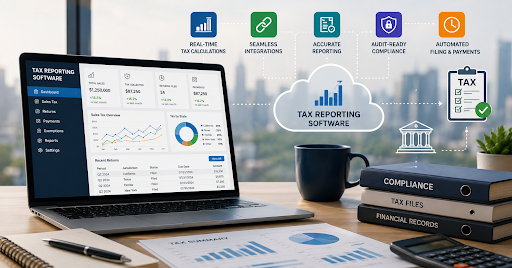
Financial compliance management is perhaps the most resource-hungry job for a business organization. Due to expanding tax codes of municipalities, complicated payroll of remote workers, and regional borders that do not apply to online transactions, manual compliance with local legislation does not fit anymore. Any inaccuracies in your accounting system can result in hefty fines imposed by the authorities.
Use of specialized tax reporting software will allow you to relieve the burden of financial compliance management.
Whether you are a scaling e-commerce merchant handling multi-state orders or a small business owner looking to centralize your year-end reporting, choosing the correct digital platform is a vital milestone. The right corporate infrastructure acts as a protective shield for your revenues while unburdening your internal accounting teams. Let’s break down the essential features, platform categories, and comparison metrics you need to consider before making a choice.
The Core Pillars of Modern Corporate Tax Systems
When evaluating enterprise compliance tools, you should look beyond basic data entry forms. The premier platforms on the market function as comprehensive, live financial hubs that actively sync with your daily sales, billing accounts, and inventory management pipelines.
A modern enterprise compliance platform relies on specific automated pillars to safeguard your filings:
- Real-Time Rate Evaluation: Tax jurisdictions change constantly. Premium software updates automatically in the cloud, calculating exact local rates down to precise neighborhood boundaries.
- Integration of Omnichannel: Your compliance solution needs to be integrated automatically with your e-commerce platforms, POS solutions, and main corporate banks without requiring any manual uploading of the data.
- Audit Traces: In case you need a look-back from the regulatory authorities, the platform will need to ensure clean data trails, historical invoices, and cryptographic logs for each transaction.
- Automatic Return Document Preparation: The platform will have the ability to automatically prepare the tax returns, thus ensuring no errors while filing.
Evaluating Platforms for Specialized Business Scales
The dynamic needs of an enterprise vary significantly based on your transactional volume, geographic footprint, and core business model. Finding the perfect match requires aligning your operational scale with the software’s structural design.
Finding the Best Software for Sales Tax Reporting
Managing economic nexus laws is the biggest concern for online retailers and brand distributors in different locations. Using the right kind of software for sales tax will enable automatic tax collection whenever your earnings exceed certain thresholds in particular regions.
There are some great solutions in this space such as Avalara AvaTax, TaxJar, and Sovos; cross-border taxes, local taxes, and multi-channel tax reconciliation is handled easily by these solutions.
Selecting the Best Small Business Tax Reporting Software
If you are running a smaller or more localized business, your ideal software solution should focus on easy bookkeeping and automated reminders for payments.
The best small business tax reporting software options include TurboTax Business, QuickBooks Online Advanced, and Xero, which excel in terms of simplicity. Their specialties lie in the capture of deductible operating expenses, 1099 independent contractor income distribution, and profit/loss statement creation.
Critical Selection Checklist for Corporate Buyers
Before committing your financial data to a fresh software vendor, run your finalists through this definitive performance checklist to ensure a high return on investment:
| Feature Bucket | Critical Requirement | Operational Impact |
| System Compatibility | Native REST API integrations with your existing ERP and CRM. | Eliminates manual data exports and human typing mistakes. |
| Exemption Management | Built-in systems to collect, verify, and store B2B tax exemption certificates. | Prevents compliance gaps during routine corporate audits. |
| Filing Automation | Auto-file capabilities that submit returns and remit payments directly to agencies. | Saves dozens of manual administrative hours every month. |
| Security Standards | Enterprise-grade SOC 2 Type II compliance with multi-factor authentication. | Protects sensitive corporate banking and consumer profile records. |
Implementation Action Plan for Financial Leadership
Transitioning your company to an automated tax compliance platform requires a planned, step-by-step approach to avoid disrupting your daily accounting cycles.
1. Map Data Flows and Connection Points:
Phase 1: Architecture.
Audit your current invoicing, digital checkout, and accounting systems. Clearly define where financial transaction data originates and how it will pass into your new reporting tool.
2. Execute Sandbox Testing and Parallel Runs:
Phase 2: Validation.
Run the new platform in a restricted sandbox or test environment alongside your legacy system for at least one full monthly cycle. Verify that the software’s automated calculations match your manual audits exactly.
3. Conduct Core Team Training Seminars:
Phase 3: Education.
Train your internal bookkeeping, payroll, and fulfillment teams on the software’s dashboard, exemption workflows, and anomaly reporting features before going live.
4. Go Live and Schedule Continuous Audits:
Phase 4: Activation.
Switch the platform into full production mode. Establish quarterly internal reviews to check configuration parameters, update nexus settings, and verify that API integrations remain completely secure.
What is the biggest mistake businesses make when integrating automated tax systems?
The biggest mistake is assuming the software operates entirely on autopilot without initial configuration tuning. Many operations teams connect a platform to their storefront but fail to properly map their specific products to the correct regulatory tax codes. Because different regions apply completely unique tax rules to things like apparel, digital software downloads, and food products, generic mapping can cause systemic over-collection or under-collection, exposing your brand to major compliance liabilities down the road.
Secure Your Corporate Compliance Infrastructure
Business automation is not about doing things half-way; it’s about creating a robust system for your growth in the future. By selecting an appropriate infrastructure that would fit your operations, make it easier to track your sales, and comply with the local rules, you protect yourself from potential risks. It’s time to get a centralized account monitoring system and learn more about professional preparation tools. Explore curated platforms and elite compliance resources at Tax Office Portal to confidently optimize your business operations today.
